

3 Bài tập thực hành môn Tiếng Anh Lớp 9
 11 trang
02/12/2025
1000
11 trang
02/12/2025
1000
Bạn đang xem tài liệu "3 Bài tập thực hành môn Tiếng Anh Lớp 9", để tải tài liệu gốc về máy hãy click vào nút Download ở trên.
Tóm tắt nội dung tài liệu: 3 Bài tập thực hành môn Tiếng Anh Lớp 9
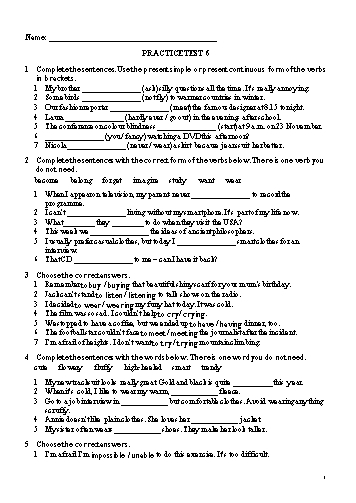
 Name: ___________________________________________
 PRACTICE TEST 6
1 Complete the sentences. Use the present simple or present continuous form of the verbs
 in brackets.
 1 My brother _______________ (ask) silly questions all the time. It’s really annoying.
 2 Some birds _______________ (not fly) to warmer countries in winter.
 3 Our fashion reporter _______________ (meet) the famous designer at 8.15 tonight.
 4 Laura _______________ (hardly ever / go out) in the evenings after school.
 5 The conference on colour blindness _______________ (start) at 9 a.m. on 23 November.
 6 _______________ (you / fancy) watching a DVD this afternoon?
 7 Nicola _______________ (never / wear) a skirt because jeans suit her better.
2 Complete the sentences with the correct form of the verbs below. There is one verb you
 do not need.
 become belong forget imagine study want wear
 1 When I appear on television, my parents never _______________ to record the
 programme.
 2 I can’t _______________ living without my smartphone. It’s part of my life now.
 3 What ________ they ________ to do when they visit the USA?
 4 This week we _______________ the ideas of ancient philosophers.
 5 I usually prefer casual clothes, but today I _______________ smart clothes for an
 interview.
 6 That CD _______________ to me – can I have it back?
3 Choose the correct answers.
 1 Remember to buy / buying that beautiful shiny scarf for your mum’s birthday.
 2 Jack can’t stand to listen / listening to talk shows on the radio.
 3 I decided to wear / wearing my furry hat today. It was cold.
 4 The film was so sad. I couldn’t help to cry / crying.
 5 We stopped to have a coffee, but we ended up to have / having dinner, too.
 6 The football star couldn’t face to meet / meeting the journalist after the incident.
 7 I’m afraid of heights. I don’t want to try / trying mountain climbing.
4 Complete the sentences with the words below. There is one word you do not need.
 cute flowery fluffy high-heeled smart trendy
 1 My new tracksuit looks really great. Gold and black is quite __________ this year.
 2 When it’s cold, I like to wear my warm, ____________ fleece.
 3 Go to a job interview in ____________ but comfortable clothes. Avoid wearing anything
 scruffy.
 4 Annie doesn’t like plain clothes. She loves her ____________ jacket.
 5 My sister often wears ____________ shoes. They make her look taller.
5 Choose the correct answers.
 1 I’m afraid I’m impossible / unable to do this exercise. It’s too difficult.
 1 At the Invisible Exhibition, you can learn about the practical aspects of being blind. Try out
useful devices that make life easier for visually-impaired people, such as talking clocks,
Braille typewriters, and computer screen reading software. Have a go at crossing the road
using a walking stick with a sensor. Experience what it is like to do your shopping without
seeing what you are buying, or build first impressions of a person based on their voice and
tone, not on their appearance.
But there is more to life than practicality! The Exhibition also allows you to explore art:
touch sculptures, hear descriptions of paintings and photographs, and listen to music in
complete darkness. Experience what it feels like to have dinner in the dark. Spend an evening
at the Invisible Restaurant: eat in a relaxed atmosphere, surrounded by the tastes and smells
of a delicious meal, and the sounds of good conversation and quiet music. Bring someone on
a real blind date – and show them a world they have never ‘seen’ before.
To book tickets for the exhibition or a table for dinner (Thursdays only), call 020 771 4236.
Allow 90 minutes for the exhibition, and around three hours for dinner.
Exhibition runs from Saturday 9th April until 3rd September.
Prices: Exhibition €5; two-course dinner €16; four-course dinner €22. Download the menu
on our website.
1 The new exhibition allows people to
 a understand how much we rely on our sight.
 b experience the power of senses other than sight.
 c experience the world using all of their primary senses.
 d see details that they may have overlooked.
2 The exhibition is designed
 a to demonstrate innovations which help people in their everyday lives.
 b to allow more people to experience culture and art.
 c for blind people to socialise and meet other blind people.
 d to help sighted people understand what life is like for blind people.
3 When you explore art at the exhibition, you
 a can feel objects and listen to people talking about pictures.
 b can compare experiences in light and in darkness.
 c can only use your sense of touch.
 d can listen to artists talking about their sculptures.
4 At the restaurant, you
 a must book a table for two.
 b can choose between two different menus.
 c can have conversations with blind people.
 d can choose the dishes you want by tasting them first.
5 The purpose of the text is to
 a inform people about a permanent museum display.
 b give a review of an unusual restaurant.
 c encourage people to sympathise with people who have disabilities.
 d advertise a new and stimulating experience.
 3 PRACTICE TEST 7
B. READING AND WRITING
I. Choose the word in each group that has the underlined part pronounced differently
from the rest.(0,6P)
1. A. campus B. relax C. locate D. fashion
2. A. qualify B. baggy C. grocery D. scenery
3. A. together B. worthy C. ethnic D. although
II. Choose one option that has the SIMILAR meaning to the word given.(0,6P)
4. precious
 A. priceless B. valuable C. worthless D. useless
5. spacecraft
 A. spaceman B. spacewalk C. spacesuit D. spaceship
6. fall
 A. spring B. summer C. autumn D. winter
I. Match the sentence in column A with its reply in column B (1,2p)
 Column A Column B
 7. Hello, you must be Maryam. A. Why don’t you take a rest?
 8. It’s a great presentation. B. That’s a good idea. Let’s do that.
 9. I am so tired. C. I enjoy it, too.
 10. My grades are terrible. D. It’s nice of you to say so.
 11. I love watching the news. E. That’s right, I am.
 12. We should burn trash to reduce the F. You should study harder.
 garbage we produce.
 ANSWER: .
IV. Choose the correct answer to complete each of the following sentences. (0,8pt)
13.______ is a complete mystery how they ever got there in that car.
 A. There B. That C. It D. This
14.This poem shows the wonderful__________ of the poet.
 A. sensitiveness B. sensibility C. sensation D. sense
15.If you wish to take photographs you’ll have to have___________________ .
A.an application B. a permit C. an allowance D. an admission
16.The students were slow to catch ______________ , but gradually they began to understand.
 A.in B. on C. away D. out
17.The soldier was punished for_______ to obey his commanding officer’s order.
 A. refusing B. regretting C. objecting D. resisting
18.She’ll be a millionaire by the time she_______forty.
 A.is B. was C. will be D. is going to be
19. Some of the passengers spoke to reporters about their______ in the burning plane.
 A. occasion B. happening C. event D. experience
20._______ the rise in unemployment, people still seem to be spending more.
 5 from melting was of course mistaken, for it was the melting of the ice that performed the
cooling. Nevertheless, early efforts to economize ice included wrapping the ice in blankets,
which kept the ice from doing its job. Not until near the end of the nineteenth century did
inventors achieve the delicate balance of insulation and circulation needed for an efficient
icebox.
But as early as 1803, an ingenious Maryland farmer, Thomas Moore, had been on the right
track. He owned a farm about twenty miles outside the city of Washington, for which the village
of Georgetown was the market center. When he used an icebox of his own design to transport
his butter to market, he found that customers would pass up the rapidly melting stuff in the rubs
of his competitors to pay a premium price for his butter, still fresh and hard in neat, one-pound
bricks. One advantage of his icebox, Moore explained, was that farmers would no longer have
to travel to market at night in order to keep their produce cool.
36. What does the passage mainly discuss?
A. The influence of ice on the diet
B. The development of refrigeration
C. The transportation of goods to market
D. Sources of ice in the nineteenth century
37. According to the passage, when did the word “icebox” become part of the language of the
United States?
A. In 1803 B. Sometimes before 1850
D. During the Civil War D. Near the end of the 19th century
38. The phrase “forward-looking” in the first paragraph is closest in meaning to__________.
A. progressive B. popular C. thrifty D. well-established
39. The author mentions “fish” in the first paragraph because__________ .
A. many fish dealers also sold ice
B. fish was shipped in refrigerated freight cars
C. fish dealers were among the early commercial users of ice
D. fish was not part of the ordinary person’s diet before the invention of the icebox
40. The word “it” in the first paragraph refers to_________ .
A. fresh meat B. the Civil War C. ice D. a refrigerator
41. According to the passage, which of the following was an obstacle to the development of the
icebox?
A. Competition among the owners of refrigerated freight cars
B. The lack of a network for the distribution of ice
C. The use of insufficient insulation
D. Inadequate understanding of physics
42. According to the information in the second paragraph, an ideal icebox would _______.
 7 PRACTICE TEST 8
B. PHONETICS:
I. Choose the word whose underlined part is pronounced differently from that of the others by
circling A, B, C or D and write your answers into the box below. (0.5pt)
1. 1. A. drive B. drink C. sky D. ride
2. A. laughed B. decided C. started D. invented
II. Choose the word (A, B, C or D) that differs from the others in the position of the primary
stress. Write your answers into the box below. (0.5pt)
1. A. questionnaire B. introduce C. recommend D. concentrate
2. A. continuous B. scandalous C. malicious D. delicious
C. GRAMMAR AND STRUCTURE:
I. Choose the word/ phrase (A, B, C or D) that best fits the space in each sentence. (2.5pts)
1. Disneyland _____________its 60th birthday on Saturday 18 July, 2015.
 A-celebrated B-congratulated C-complicated D- completed
2. _____________the 3rd day of the Lunar New Year, pupils often pay their teachers a visit.
 A-to B-on C-in D-at
3. Our little son was sleepy when we were walking to the park;__________, we went home
 early.
 A-therefore B-however C-moreover D-although
4. People ____________do not love nature may not love anything else in life.
 A-whom B-whose C-which D-who
5. Speaker 1: “Excuse me. Do you mind if I sit here?” – Speaker 2: “______________”
 A-You’re right. B-Not at all! Go ahead. C-Sure, thanks. D- Really? Good!
6. The small bamboo forest ____________the entrance to the village makes it picturesque.
 A-at B-in C-on D-to
7. About 70% of the earth’s _______________is covered with water.
 A-world B-atmosphere C-ocean D-surface
8. The teacher ____________Van if she had ever tried calling a helpline.
 A-said B-advised C-asked D- suggested
9. Speaker 1: “______________” - Speaker 2: “Sơn Đoòng is a new tourist destination.”
 A- Let’s eat out this evening! B-We need a holiday, dear!
 C-I miss my relatives in Huế! D-I’d like to cook something special food
10. I chose to buy the house in District 9 ___________avoid noise and pollution.
 A-so that B-in order that C-so as to D-in order not
II. Choose the underlined word or phrase (A, B, C or D) that needs correcting. (0.5 pt)
11. One of the great pleasures of to travel to another country is eating different dishes.
 A B C D
12. The drought that caused by El Nino weather patterns is hitting Thailand and
 A B C D
 Cambodia.
III. Choose the correct form of the word given in each sentence. (0.5 pts)
1. The local government has plans to _____________this city. [modern]
2. That exchange student can speak English and Spanish ___________. [fluent]
D. READ:
I. Read the text carefully and then choose the best answers to the questions below by
circling the corresponding letter A, B, C or D. (1 point)
 9
File đính kèm:
- 3_bai_tap_thuc_hanh_mon_tieng_anh_lop_9.doc


