

Bài tập ôn tập môn Tiếng Anh 6 - Unit 7: Television
 16 trang
01/12/2025
770
16 trang
01/12/2025
770
Bạn đang xem tài liệu "Bài tập ôn tập môn Tiếng Anh 6 - Unit 7: Television", để tải tài liệu gốc về máy hãy click vào nút Download ở trên.
Tóm tắt nội dung tài liệu: Bài tập ôn tập môn Tiếng Anh 6 - Unit 7: Television
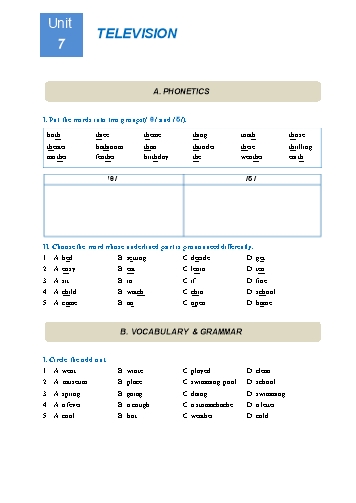
 Unit
 TELEVISION
 7
 A. PHONETICS
I. Put the words into two groups (/ θ / and / δ /).
 both three theme thing tooth those
 theater bathroom than thunder there thrilling
 mother feather birthday the weather earth
 / θ / / δ /
II. Choose the word whose underlined part is pronounced differently.
1. A. bed B. setting C. decide D. get
2. A. easy B. eat C. learn D. tea
3. A. sit B. in C. if D. fine
4. A. child B. watch C. chin D. school
5. A. come B. no C. open D. home
 B. VOCABULARY & GRAMMAR
I. Circle the odd out.
1. A. went B. wrote C. played D. clean
2. A. museum B. place C. swimming pool D. school
3. A. spring B. going C. doing D. swimming
4. A. a fever B. a cough C. a stomachache D. a letter
5. A. cool B. hot C. weather D. cold 16. Millions of children the world enjoy the show.
 A. all B. in C. around C. over
17. The game show this week will test you general about Amazon jungle.
 A. schedule B. knowledge C. fact D. adventure
18. The program can both and entertain young audiences.
 A. educated B. education C. educational D. educate
19. The I like best is Xuan Bac.
 A. comedy B. comedian C. fun D. funny
20. Where are the children? They in the yard.
 A. play B. are playing C. is playing D. plays
IV. Fill in the blank with What, Where, When, Why, Who, How, How far.
 Ex: What is your name? - My name‟s Trung.
1. is your family name? - It‟s Nguyen.
2. old are you? - I‟m thirteen.
3. do you live? - On Nguyen Trai Street.
4. do you live with? - My parents.
5. is it from your house to school? - About three kilometers.
6. do you go to school? - By bus.
7. do you go to school? - At half past six.
8. are you late? - Because I miss the bus.
V. Fill in the blank with although, and, because, but, or, since, so, unless, until, when.
1. Things were different ......................... I was young.
2. I do it ......................... I like it.
3. Let us wait here ......................... the rain stops.
4. You cannot be a lawyer ......................... you have a law degree.
5. She has not called ......................... she left last week.
6. I saw him leaving one ......................... two hours ago.
7. This is an expensive ......................... very useful book.
8. We were getting tired ......................... we stopped for a rest.
9. He was angry ......................... he heard when happened.
10. Walk quickly ......................... you will be late.
11. He had to retire ......................... of illness.
12. We will go swimming next Sunday ......................... it doesn‟t rain.
13. I heard a noise ......................... I turned the light on.
14. Would you like a coffee ......................... tea?
VI. Complete the following sentences with the words in the box.
 and but so because although
1. Children love cartoons they make them feel happy.
2. the newsreader speaks really fast, my father can hear everything.
3. The animal programme is late I can‟t wait for it. D. WRITING
I. Make sentences using the future simple tense: will + verb (inf. without to).
 Ex: I/ go/ the supermarket/ tomorrow
 I’ll go to the supermarket tomorrow.
1. We/ travel/ Nha Trang/ next week
 ................................................................................................................................................
2. Nga and Lan/ visit/ their grandparents
 ................................................................................................................................................
3. They/ go/ the movies/ tonight
 ................................................................................................................................................
4. Hoa/ have/ lots of friends/ soon
 ................................................................................................................................................
5. I/ come/ after lunch
 ................................................................................................................................................
6. He/ see/ you/ tomorrow afternoon.
 ................................................................................................................................................
7. My father/ be free/ at 7.30 this evening
 ................................................................................................................................................
8. The students/ go camping/ next Sunday
 ................................................................................................................................................
II. Make the sentences using a conjunction: but; and; or; so.
1. We know him. We know his friends.
 ................................................................................................................................................
2. The coat was soft. The coat was warm.
 ................................................................................................................................................
3. It is stupid to do that. It is quite unnecessary.
 ................................................................................................................................................
4. I wanted to go. He wanted to stay.
 ................................................................................................................................................
5. Your arguments are strong. They don‟t convince me.
 ................................................................................................................................................
6. You can go there by bus. You can go there by train.
 ................................................................................................................................................
7. I was feeling tired. I went to bed when I got home.
 ................................................................................................................................................ 6. will your father travel to Ha Noi? - He will travel next week.
7. will Nam go to bed early tonight? - Because he will have a test tomorrow.
8. will you go next summer vacation? - I will go to Nha Trang.
V. Arrange the suitable dialogue.
 This is Nga. When will she come back?
 Hello. Can I speak to Trang?
 1 Hello. This is 8 630 842.
 She‟ll be back at about half past four.
 I‟m sorry. She‟s out at the moment. Who is calling?
 all right. Please tell her I‟ll call again at five.
 Thank you. Goodbye.
 OK. I‟ll tell her.
 Bye.
VI. Fill in the blank with the words in the box.
 Where When Will Would is Who at see
Mai: Hello. This is 8 942 810.
Phong: Hello. (1) that Mai?
Mai: Yes. (2) is this?
Phong: It‟s me, Phong. (3) you be free tomorrow afternoon?
Mai: Yes, I will.
Phong: (4) you like to play tennis?
Mai: Sure. (5) will we play?
Phong: We‟ll play at Lan Anh court.
Mai: (6) will we meet?
Phong: We‟ll meet (7) three o‟clock.
Mai: OK. I‟ll (8) you tomorrow. 6. I must go now. It gets late _______
7. I usually go to work by car _______
8. “Hurry up! It’s time to leave”. “I come” _______
9. I hear you’ve got a new job. How do you get on? _______
10. John is never satisfied. He always complain _______
 PREPOSITION
I. Fill in each blank with an appropriate preposition where is necessary
1. I listened ______ the news ______ the radio.
2. I’ll see you ______ 9.00 ______ the morning
3. Don’t tell anyone ______ me
4. I live ______ a flat ______ Paris
5. I’m looking ______ my neighbour’s cat while she’s on holiday
6. I waited twenty minutes ______ a bus yesterday. for
7. What are you doing ______ this evening?
8. She arrived ______ England two years ago
9. I’d like to book a table ______ twelve ______ 6:30 this evening
10. I’m going ______ home
11. I spoke ______ Mary a few days ago
12. My sister’s coming to stay ______ December 19
13. The differences ______ British English and American English are small
14. She’s arriving ______ Monday
15. Janet doesn’t take good ______ himself
16. It’s very cold here ______ night
17. I never work ______ the weekend
18. I’m a little short ______ money
19. School starts ______ September 5th
20. I’ll see you ______ lunchtime
21. I normally go to the south of France ______ the winter. I usually go ______ December, but ______
last December I couldn’t go because my wife was ill
22. We are ashamed ______ his behaviour
23. Mr. Smith is not accustomed ______ hot weather
24. My home is far ______ school
25. Ken was proud ______ his good marks on English
26. My plan is similar ______ your, but it is different ______ Ken’s
27. We’ll leave ______ eleven o’clock ______ Saturday morning
28. Shall we visit George ______ Spain ______ next April?
29. I always drink two cups of coffee ______ breakfast. ______ the afternoon, I drink tea. I drink hot milk
______ night before I go to bed
30. They play golf ______ every Tuesday ______ the summer
31. I gave her a painting ______ her birthday ______ June this year
32. The children are playing ______ the grass ______ the park
33. Does this bus stop ______ the railway station?
34. I live in a flat ______ the fifth floor
35. There is a queue of people ______ the bus stop
36. My mother is always busy ______ her housework
37. The air at the seaside is good ______ health
38. My friend is good ______ Maths and Physics
39. I put the books ______ the table
40. The butter is ______ the fridge
41. We are grateful ______ our teacher
42. The beach is full ______ tourists in summer
43. I met her ______ the party a. at b. in c. on d. to
23. She learnt French _____________ listening to tapes
a. by b. for c. on d. with
24. The rooms were full _____________ old furniture
a. of b. with c. from d. off
25. “Don’t forget to take _____________ your shoes when you are in a Japanese house
a. in b. off c. up d. apart
26. Who’s going to look _____________ the children while you’re away?
a. up b. after c. over d. at
 COMPARISON
I. Forming comparatives and superlatives:
happy happier happiest thin
beautiful busy
new patient
neat young
hot bad
good comfortable
handsome rude
mean sad
generous large
II. Complete the sentences using the correct form of the adjectives or adverbs in brackets
1. Mary is (pretty) ________________ as her sister
2. A new house is (expensive) ________________ than an old one
3. His job is (important) ________________ than mine
4. Of the foour ties, I like the red one (well) ________________
5. Nobody is (happy) ________________ than Miss Snow
6. Today English is the (international) ________________ of language
7. John is much (strong) ________________ than I thought
8. Benches are (comfortable) ________________ than arm-chairs
9. Bill is (good) ________________ than you thought
10. Mr. Bush is the (delightful) ________________ person I have ever know
11. Bill is (lazy) ________________ and (lazy) ________________
12. It becomes (hard) ________________ and (hard) ________________ to find a job
13. As the conversation went on, he became (talkative) ________________
14. As I waited for my interview, I became (nervous) ________________
15. Is the book (interesting) ________________ than the one you read last week?
III. Cirle the best option to complete each sentence:
1. This is the _________ river in the world
a. most long b. longest c. long most d. longer
2. Do you think older people drive _________ than younger people?
a. slow b. slower c. more slow d. more slowly
3. They all dance well, but John dances _________
a. better b. more good c. the better d. the best
4. Your computer is more expensive than _________
a. me b. my c. mine d. myself
5. My car isn’t very new. Your car is _____ than my car
a. newer b. older c. not new d. less new
6. Who is _____ in your class?
File đính kèm:
- bai_tap_on_tap_mon_tieng_anh_6_unit_7_television.docx


