

Bài tập ôn tập môn Tiếng Anh 7 - Unit 7
 7 trang
01/12/2025
790
7 trang
01/12/2025
790
Bạn đang xem tài liệu "Bài tập ôn tập môn Tiếng Anh 7 - Unit 7", để tải tài liệu gốc về máy hãy click vào nút Download ở trên.
Tóm tắt nội dung tài liệu: Bài tập ôn tập môn Tiếng Anh 7 - Unit 7
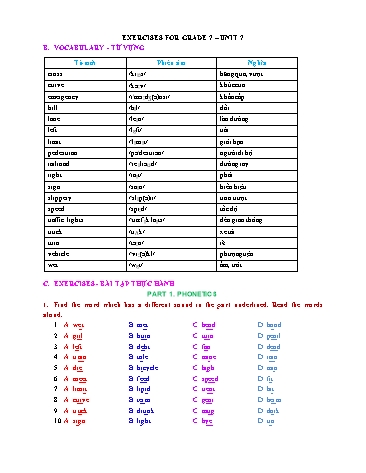
 EXERCISES FOR GRADE 7 – UNIT 7
B. VOCABULARY - TỪ VỰNG
 Từ mới Phiờn õm Nghĩa
 cross /krɒs/ băng qua, vượt
 curve /kəːv/ khỳc cua
 emergency /iˈməːdʒ(ə)nsi/ khẩn cấp
 hill /hɪl/ đồi
 lane /leɪn/ làn đường
 left /lɛft/ trỏi
 limit /ˈlɪmɪt/ giới hạn
 pedestrian /pəˈdestriən/ người đi bộ
 railroad /ˈreɪlrəʊd/ đường ray
 right /raɪt/ phải
 sign /saɪn/ biển hiệu
 slippery /ˈslɪp(ə)ri/ trơn trượt
 speed /spiːd/ tốc độ
 traffic lights /ˈtrổfɪk laɪts/ đốn giao thụng
 truck /trʌk/ xe tải
 turn /təːn/ rẽ
 vehicle /ˈviː(ə)kl/ phượng tiện
 wet /wɛt/ ẩm, ướt
C. EXERCISES - BÀI TẬP THỰC HÀNH
 PART 1. PHONETICS
1. Find the word which has a different sound in the part underlined. Read the words
aloud.
 1. A. wet B. met C. head D. hand
 2. A. girl B. burn C. turn D. pearl
 3. A. left B. debt C. fan D. dead
 4. A. train B. tale C. mine D. rain
 5. A. die B. bicycle C. high D. min
 6. A. meet B. feed C. speed D. fit
 7. A. limit B. lipid C. treat D. hit
 8. A. curve B. term C. gear D. herm
 9. A. truck B. drunk C. mug D. dark
 10. A. sign B. light C. bye D. tin B. Minimum speed is 5. B. There are cattle ahead.
C. Only 5 MPH is allowed. C. There are wild animals ahead.
D. Speed limit is lower than 25 D. Cattle are not allowed.
MPH.
2. 5.
A. Cars cannot be sold here. A. Bullying is allowed.
B. Cars and trucks can pass. B. Bully may be arrested.
C. Cars are not allowed. C. Bullying must be stopped.
D. Bicycles are not allowed. D. This zone is dangerous.
3. 6.
A. You cannot return. A. Cameras are used here.
B. Go ahead isn't allowed. B. You can't use your camera here.
C. You must return. C. Cameras are sold ahead.
D. Watch out the pedestrians. D. Take photograph when crossing road.
2. Find one odd word A, B, C or D.
 1. A. train B. plane C. plant D. car
 2. A. left B. right C. straight D. square
 3. A. green B. red C. orange D. light
 4. A. drive B. write C. ride D. fly
 5. A. fast B. rapid C. slow D. quick
3. Put questions for the underlined parts in the following sentences, using question words
in brackets.
 1. Nam usually goes to school by bus. Sometimes, he rides his bicycle. (How)
 ________________________________________________________________________
 2. My grandfather used to go fishing in the West Lake every afternoon. (What)
 ________________________________________________________________________
 3. There are a lot of trucks and cars on the highway in the rush hour. (Where)
 ________________________________________________________________________
 4. The students used to be taught about road signs when they studied in secondary school.
 (What)
 _____________________________________________________________________
 5. Hung always drives his car very carefully. (How)
 ________________________________________________________________________
 6. It is about 100 km from Ha Noi to Hai Phong. (How long)
 ________________________________________________________________________
4. Fill each blank with suitable words in the box. human traffic, vehicular traffic also increases. As the standard of living is (become)
high everyone wants to (purchase) his own car.
 PART 3: READING
1. Fill in the blank with a word/ phrase in the box.
 trains discourage transport expensive
 example problem cities pollution
 Traffic congestion in many (1) around the world is severe. One possible solution to
this (2) is to impose heavy taxes on car drivers and use this money to make public
transport better. One of the first benefits of such a measure is that the heavy taxes would (3)
 car owners from using their cars because it would become very (4) to drive. This
would mean that they would begin to make use of public (5) instead, thus reducing
traffic problems and (6) as well. Another benefit would be that much more use
would be made of public transport if it was improved. It is often the case that public transport in
cities is very poor. For (7) , we often see old buses and (8) that
people would rather not use. High taxes would generate enough money to make the necessary
changes.
2. Read the passage and answer the questions.
 The first traffic control device appeared near the British House of Parliament at the
intersection of George and Bridge Streets. The device was made in response to the desire by a
Select Committee to use railway signals on highways. The device had lights and it used arms
which extended outwards. It was operated manually by a police officer. The signal was 22 feet
high and crowned with a gas light. The light was called semaphore and had arms that would
extend horizontally that commanded drivers to "Stop" and then the arms would lower to a 45
degrees angle to tell drivers to proceed with "Caution". At night a red light would command
"Stop" and a green light would mean use "Caution". The man behind this new and different
invention was John Peake Knight a railroad engineer. The main reason for the traffic light was
that there was an overflow of horse-drawn traffic over Westminster Bridge which forced
thousands of pedestrians to walk next to the house of Parliament. But Knight's invention was not
to last long. After only a month of use the device exploded and injured the police officer who
was operating the light. In the first two decades of the 20th century semaphore traffic signals,
like the one in London, were in use all over the United States with each state having its own
design of the device. One good example was from Toledo, Ohio in 1908. The words "Stop" and
"Go" were in white on a green background and the lights had red and green lenses illuminated by
kerosene lamps for night travelers and the arms where eight feet above ground. Controlled by a
traffic officer who would blow a whistle before changing the commands on this signal to help
alert travelers of the change, the design was also used in Philadelphia and Detroit. The example
in Ohio was the first time America tried to use a more visible form of traffic control that evolved
the use of semaphore. The device that was used in Ohio was designed based on the use of
railroad signals. 5. Lana/ use to/ on foot/ school/ or/ car?
 ................................................................................................................................................
 6. He/ used/ good/ student/ but/ now/ poor.
 ................................................................................................................................................
 ________________________________________________________________________
2. Rewrite the following sentences so that their meaning stays the same, using the word
given for each.
 1. My father is always a careful driver. DRIVES
 ______________________________________________________
 2. The distance from Ha Noi to Hai Phong is about 100 km. IT
 ______________________________________________________
 3. Be careful or you'll have an accident. IF
 ______________________________________________________
 4. Hung went to his homeland by train some years ago, but now he drives his USED
 car.
 ______________________________________________________
 5. Road users should obey traffic rules strictly. OBEYED
 ______________________________________________________
 6. Is it possible to travel to Korea by car? CAN
 ______________________________________________________
 7. Buses leave for Hai Phong every 15 minutes from 6 a.m to 10 p.m. THERE
 ______________________________________________________
 8. My family was very poor in the past, but we have 100 million USD now. USED
 ______________________________________________________
File đính kèm:
- bai_tap_on_tap_mon_tieng_anh_7_unit_7.docx


